
In all Medieval handbooks of Geomancy, this method of divination is called something like “a brief science”, meaning an art that can be mastered with little effort. It was often sold as some kind of quick, “portable” oracle. This, I presume, is in comparison with Astrology, which back then required no small amount of mathematical knowledge, astrological software still being a couple of years away.
By comparison, anyone who can memorize a couple of meanings and rules and is capable of producing a Geomantic Shield (i.e., the chart) can obtain a quick answer.
The more I delve into Geomancy’s Medieval practice, the more I realize that all modern attempts at reviving it hinge on some kind of rationalization or optimization of what was, essentially, a rather chaotic (though not random) method. It is typical of the pre-modern approach to rely on older authority and compile as many observations and rules as possible from previous sources, even when contradictory with each other, so as to have an endless array of techniques to throw at the chart in hopes of teasing out the wanted response. This is not unlike what modern astrologers do when they interpret birth charts, though I must say, unlike contemporary astrology, traditional geomancy does work.
Producing a Geomantic Shield, Step by Step
If rationalization it must be, then it makes sense first to understand what it is that a geomancy reading does, that is, what it accomplishes from a structural standpoint. This is a Geomancy Shield.

In this shield, not all the figures are generated by the querent/diviner. In fact, only the figures circled in red are actively produced by the person interested in the reading. These are made from right to left, following the numbered order.

Once the four main geomantic figures (called the “four Mothers“) are produced, every other passage is automatic and relies on certain geomantic operations to fill out the Shield. One such operation is very particular, in that it only occurs once throughout the reading, while the other one is repeated many times. I’m talking about the operation that produces the “four Daughters.” This consists in taking the first line from every one of the first four figures (the mothers) to produce the fifth figure or first daughter; then taking the second line from each of the four mothers to produce the sixth figure or second daughter, and so on, until we have four mothers and four daughters (the daughters are circled in blue.)
As you can see, for instance, if you take the first line from each of the four mothers, you get a first line of two points, a second line of one point, then a third line of two points and a last, fourth line of one point, which now occupies the fifth house.
Once this operation is over, it is never repeated again, and it leaves us with a double set of four figures each. These two sets are not unrelated (hence the names of mothers and daughters.) They must of necessity be comprised of the same number of points, albeit differently shuffled around. Still, as much as they are related, they represent a split of some type, a doubling of reality from one into two related but separate sides.
Now it is a matter of producing the rest of the chart. This is done by taking the figures two by two and “adding” them line by line. We pair the first and second mother together, then the third and fourth, then the fist and second daughter together, and then the third and fourth. Adding here means taking the points that comprise each line in the two figures, adding them and seeing if you get an odd or even number: if you get an odd number, the resulting line will have one point; if you get an even number, the resulting figure line will have two points. This produces the “four Nieces” which occupy the second row in the Shield. Take careful notice that, at this point, Mothers and Daughters have not interacted with each other yet.

Once we have the Mothers, the Daughters and the Nieces, we repeat the second operation once more by pairing up the Nieces, the first with the second and the third with the fourth. As you can appreciate, once more, Mothers and Daughters haven’t come into contact: the split hasn’t been mended.
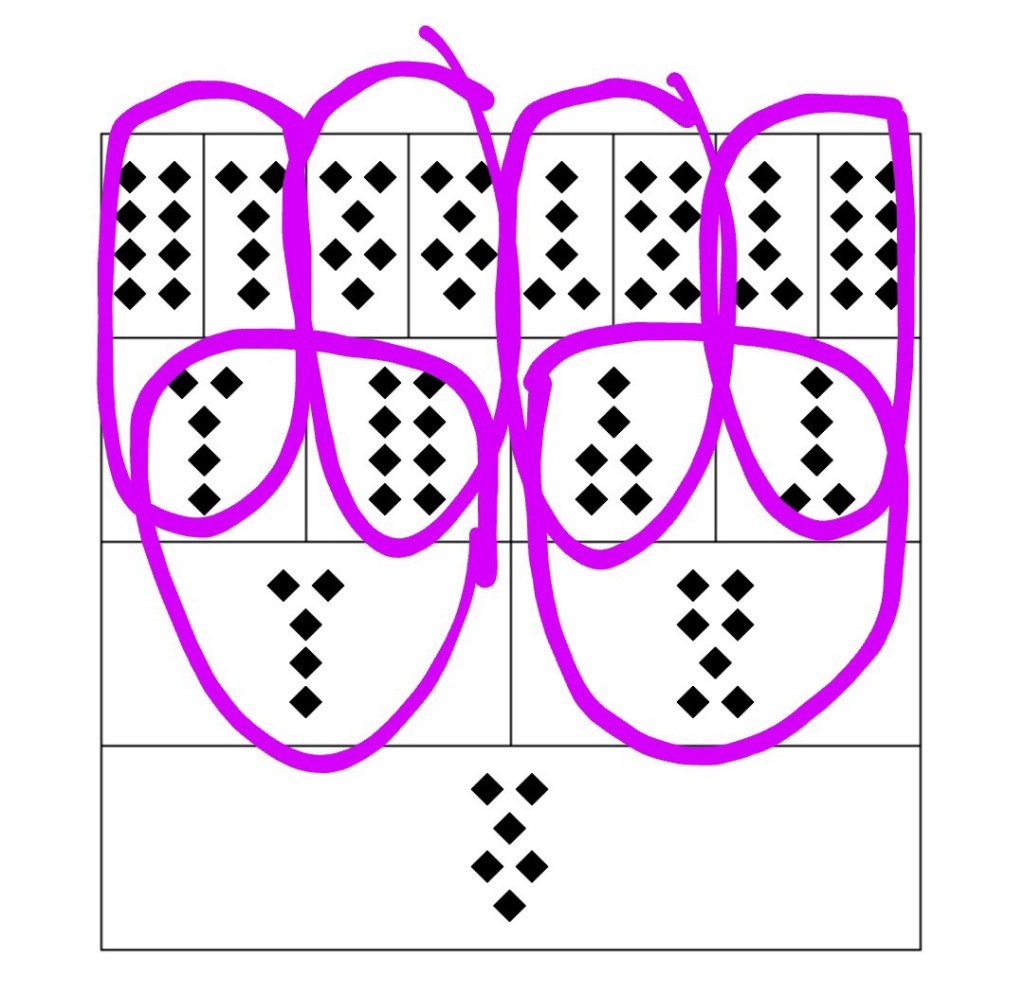
The two figures resulting from the addition of the four Nieces are the two Witnesses, which are the first two members of the “Geomantic Court.” The Right Witness is the ultimate consequence of the four Mothers, while the Left Witness is the ultimate consequence of the four Daughters. We can’t produce any more figures without finally bridging the gap between the right side of the Shield and the left side. This is done by producing the fifteenth figure, the last one, called the Judge. This brings the operation to a close.

So, What are we doing in Geomancy?
Anyone familiar with Hegel’s dialectics cannot but look in admiration at what I have just described. We begin the operation with a set of four symbols (the four Mothers) which represent the querent’s active involvement, in the hope of knowing something. A querent that doesn’t want to know anything does not consult an oracle: he is not a querent, ‘querent’ meaning ‘asker’. Therefore, the four Mothers represent the question itself, not in a divinatory sense, but in a structural one: if someone doesn’t want to know something, the Four Mothers don’t appear.
Once this happens, reality splits into two, the Right side representing the querent, the Left side the quesited. This culminates in the reading of the Geomantic Court, in which the Right Witnesses pleads for the querent and the Left one for the quesited, among other possible interpretations. Other variants are: Right side good, Left side bad, Right side past, Left side future, Right side helpful, Left side hindering. These are all variations on the same theme.
The point is that from a Geomantic standpoint, duality comes into being as a result of someone either desiring something they don’t have or fearing they might lose something they have. Objective reality comes into being by “lapsing away” as it were from the Subject, creating a would of sort that requires a series of steps in order to be healed again (‘heal’ literally meaning ‘to make whole’). Try to think of a situation where you don’t need anything: you don’t need food, clothes, air, light, aspirations. You’d be very godly or very dead.
What I just said, therefore, is not a disparaging of dualism: without duality, unity cannot manifest, and remains a sterile, barren field. Without the split, the querent wouldn’t be able to know, or, indeed, to get. By pronouncing his sentence, the Judge makes the situation whole again, which is signified by the fact that only the eight figures with an even number of points can become Judge. Either the querent gets his wish or he doesn’t. But the making whole again presupposes the split, just as in dialectics the synthetic moment cannot be understood and appreciated but through the process of opposition that led to it.
What I just described is, as far as I know, never mentioned in Medieval or Renaissance works on Geomancy–one obvious reason being that dialectics in the Hegelian sense hadn’t been invented yet. Platonic dialectics (that is, conceptual dialectics) comes close, but again, all this seems implicit in the operations of Geomancy and never articulated. I harbor no delusion therefore of having discovered the secret meaning of the art. I am conscious, in fact, that I am merely organizing it according to a model that is familiar to me. But I must say Geomancy wears this model beautifully. It contains a whole philosophy of what it means to ask a question and to get an answer.
Discover more from Moderately Quick Silver
Subscribe to get the latest posts sent to your email.
