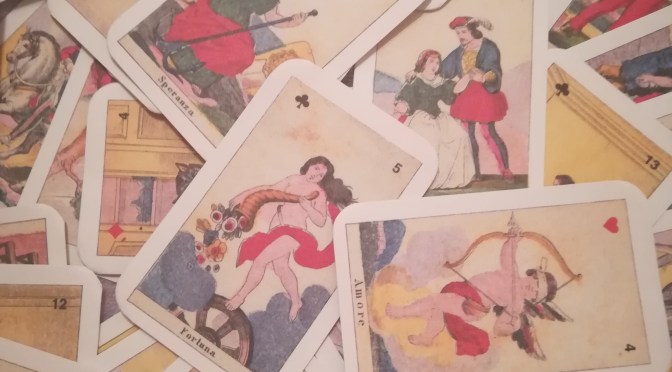
We’ve talked about some of the basics of interpreting the cards. The most important thing is to practice, though, as only your own practice can reveal how the cards communicate to you. In this light, I would like to address something that is not strictly speaking a point of interpretation, but which I find is still helpful. It’s what I would call “the moment of silence” and I believe it holds true for all card systems you study.
Especially at the beginning, when you get your hands on some cool material about the deck, your head is going to be brimming over with facts. This is a preliminary step which, I think, is unavoidable, just as it’s unavoidable, in learning a foreign language, to assimilate words and some grammar. You can go with the “natural approach”, but sooner or later, if you want to rise above mediocrity, you need some serious study.*
But study brings with it a new host of issues. Ever listened to a non native trying speak English (or your language) for the first time after completing a course? You can barely understand them. And for a good reason: they are constantly trying to reach for information in their heads that they haven’t assimilated in practice. They are trying to remember rules and exceptions and words and word connections, and the pronunciation of this or that words, all the while trying to understand what you, the native speaker, are telling them etc.
It’s a lot. Then, as they practice, they evolve toward a type of English (or any other language) that is hopelessly broken, but somewhat understandable. As they refine their skill, they assimilate in practice what they have had in their heads all the time, and their use of the language improves.
But just as you can have a bad hair day, you can also have a bad English day, or a bad German day, or a bad Italian day. It’s those days where you feel like you are here and your language skills are somewhere else and you need to constantly grope for them, which makes for some very clunky sentences and dialogues. If you are having one of those days, you need to relax, take in a deep breath, wait a moment, center yourself and stop *trying* to speak the language–and just speak it.
With divination it’s similar, with the added difficulty that there is no native speaker to learn from. But the concept of “waiting a moment” and centering yourself is still valid. Having three, five, fifteen, twenty one cards in front of you can intimidating, so you jump into it in a kind of panic and start assembling meanings. That’s not helpful. When you start a reading, always make sure to stop for a second and keep quiet. Not just quiet in the sense of not speaking, but also in the sense of not trying to have your attention drawn immediately by a tree as opposted to taking in the forest. The spread is a whole, and it must be approached as such. Take a deep breath, forbear from trying to read the cards. Let your eyes wander for a second over the whole spread without digging anywhere. Survey the territory in a kind of bird-eye view. And then speak.
* conversely, if you start with some serious study, you also need the natural approach.
Discover more from Moderately Quick Silver
Subscribe to get the latest posts sent to your email.
