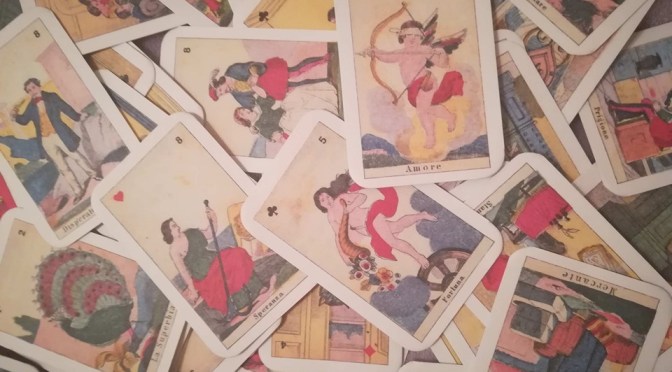
The sevens in the Vera Sibilla are mainly connected with the ideas of intentions, mindset, projects and planning. They speak, in other words, of our ability to conjure up visions of reality and of ourselves that may then be planted into the outside world and grown. While the sixes spoke of the passage of time and the flow of events, the sevens represent our ability to see an alternative that may be tapped into to alter that flow. Differently put, they show us how the Self reacts to that flow.

As it should by now be clear, Hearts and Spades are direct opposites of one another. The Seven of Hearts, the Scholar or Artist, represents the power of reason. Notice the difference between the Seven of Hearts and the Six of Diamonds, the Thought card. The latter is about our inner reality, which may or may not be reasonable. A passing look at the amount of psychic crap that comes pouring out whenever we hit a shrink’s couch shows us that the Thought card, i.e. what goes on on the inside, may bear little to no resemblance to reality in its absolute, objective sense.
The Six of Diamonds may show projects, but only in so far as they are inside and not yet outside. The Seven of Hearts, on the other hand, represents the ability to plan. It represents rationality, brain power, the ability to measure and count (when reversed, the idea of measuring and counting becomes the negative notion of ulterior motives, of doing something because you are calculating individual).
It is also the card connected with the skill of coherently putting together a vision of reality that may be used to then mold reality itself. Hence its connection with creativity and art, which are not the opposite of reason, but its extension into the world. As unfashionable as thinking straight is among us new-agey folks, this card is very important. The most important practical meaning of the Scholar, i.e. contracts, comes from the fact that the juridical side of life is founded on the concept of “meeting of minds”, which is what generates contracts: it’s when my mind meets yours midways to create a stable, reasonable intersubjective agreement.
Let’s turn to the Seven of Spades, Disaster, which is notoriously similar to the Tower card in the tarot. This card is, in more than one sense, the direct opposite of the Scholar. In its most general sense, this is the card of immeasurability. It shows all those things that, no matter how “scholarly” we might be, hit us from the outside, without forewarning and without any discernible cause that we might prepare for in advance. It shows shit happening because shit just happens, and that’s kind of it.
As an extended, neutral meaning, this card also represents things happening all of a sudden, and usually very quickly, though not necessarily in a bad sense. A third important meaning of this card is that of negative projects. While the Scholar is the good architect of reality, the Disaster card can show ill-will, the desire to hurt or harm another. It is connected with anger and choler, all forces that blur the line between what’s reasonable and what isn’t.
In between we have the Seven of Clubs, Gratification, and the Seven of Diamonds, the Child. These, too, are starkly different cards in many ways, although with a common tread. The Seven of Diamonds is the card of all things new and novel. It represents new projects, new plans, new things in general coming into our lives. More subtly, this is also the card of new visions, of opening up to new points of view, new stimuli, new perspectives and new ways of understanding ourselves and others.
Its archetype extends to cover ideas such as purity of soul, candor, innocence, but also naivety. The Suit of Diamonds is the suit of seeds, of all those little impulses, positive or negative, that are planted into our lives. Among the other Diamonds cards, the Child is the one that most of all represents a seed: small, ready to grow and full of promise and potential.
The Seven of Clubs, Gratification, is anything except small. It is deeply connected with our sense of self, with what makes us secure in our identity and what supports our narrative of who we are and of how who we are finds its deepest fulfillment in real life. If the Child is the seed, Gratification is the tree ripe with succulent, plump fruits.
This is not a “theoretical” card, but a very material one. In the most general sense, it is connected with our sense of stability in the world: it may have to do with fame, recognition, our good or bad name (depending on the cards around and on whether this one is upright or reversed). Furthermore, the Seven of Clubs has strong ties with the concept of concreteness and concretization: it shows the next logical step in making a situation more stable, concrete and fulfilling, whether it’s marriage (the ring in the picture) a promotion at work (the bag of money) or a positive reception by our fellow humans (the wreath).
As Alessandra Venturi says in her book, this card can be the light at the end of the tunnel, in that after a slew of negative cards it can allow us to regain a sense of balance and a more positive outlook. Whatever the field, this card doesn’t speak of emotions, but it does speak of personal fulfillment in the situation.
Discover more from Moderately Quick Silver
Subscribe to get the latest posts sent to your email.
