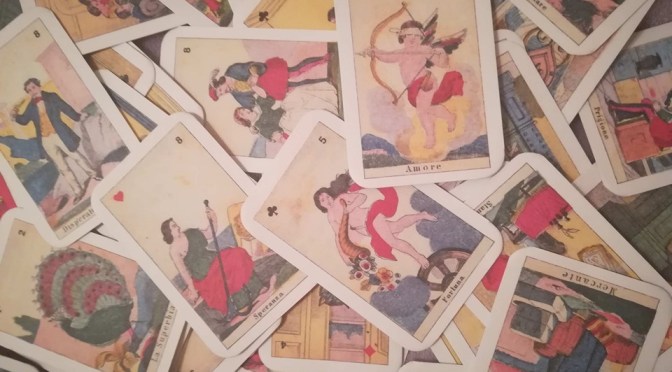
Traditional oracle cards (Vera Sibilla, Kipperkarten, Gypsy cards, etc.) are sometimes thought to be somewhat shallow and pedestrian when compared to Tarot. Take the Vera Sibilla: here you have images like the Butterfly, the House, the Letter, the Room, the Soldier, etc. You even have someone about to blow their brains out in the Jealousy card. It all sounds like Soap Opera material. Compare it with the High Priestess, the Hanged Man, the Devil, all figures which seem to warrant a greater degree of symbolic interpretation in order to yield some tangible answer.
That seems to be why we often do not look for deeper layers of meaning in our oracle cards. It’s easy to disregard them (or to treasure them, depending on where you’re coming from) as the scullery maid that does Tarot’s dirty job while her master is locked in his tastefully decorated room, listening to Händel and thinking up philosophical abstractions.
I am certainly guilty of this sin. I have been studying the Vera Sibilla for some time now, and I had never even considered the possibility of there being some numerological factor at play. This, in spite of the fact that the Sibilla is a rare instance of a traditional oracle with four complete suits, Ace through Ten plus Jack, Queen and King.

One of the reasons I tended to disregard numerology is that the way the Sibilla is taught is through its traditional meanings, upright and reversed, and then its combinations. Look at one of the very few valid books about the Sibilla out there, Alessandra Venturi’s Italian Cartomancy.
In her book, she devotes two to four pages to each card, but without any structure. All the meanings she relays are traditional, but they are thrown at the reader without any hint as to how to use them or how to prioritize them. She mentions numerology very briefly as a reason to prefer the attribution of the Handmaid card to the Eight of Diamonds, but she doesn’t explain why, and the subject of numerology is dropped altogether for all other cards.
I only started thinking about possible numerological structures when one of my favorite youtubers, the Italian card reader Etienne Valancourt, suggested in a couple of his videos that some cards with the same number do have some similarities. He makes the example of the Threes and the Fives, but he also suggests that other numbers do not seem to show any similarities among them. By the way, if you understand Italian I absolutely recommend his video course on the Vera Sibilla. I am personally waiting for his book like the second coming of Christ.
In this series of blog articles, I am going to (respectfully) challenge Etienne’s idea, and I am going to show how the core traditional meanings of all numerical cards can be boiled down to a numerological essence. Although I do use reversals, I am going to concentrate on the upright meanings only, for the simple fact the reversed meanings are often a modification of the upright ones, albeit not always.
Another important point I am going to mention is that I am not trying to say that every possible meaning of the cards can be reduced to numbers. The Two of Clubs, the Peacock, for instance, is traditionally the talisman card, the best in the deck. I suggest that the core meanings of this card, which are liberation, completion, help from above, etc. can be seen as a development of the meaning that the number Two seems to have in the Sibilla deck. But it also has other meanings, such as beauty, which seem to be derived from its iconography and archetypal essence more than from its numerical value.
In other words, I am not attempting to reduce everything to numerology, but show that numerology does play a role in this oracle deck. Nor am I suggesting that whoever drew the deck was trying to use a numerological system, but that the traditional set of meanings has, for some cosmic synchronicity, ended up developing according to a certain structure. Yes, it’s a very newagey explanation, and yes, I am ok with it.
Finally, I admit that, although I consider the system I am elaborating to be relatively well thought out, it is not necessarily perfect. I am sure that, as I keep studying this amazing deck, I will come up with more fitting numerological coordinates. I am aware of the fact that while most of my explanations fall perfectly in line with the meanings of the cards, some require a bit of mental gymnastics, which to me suggests that my system is going to have to be improved in the future.
Sure, I could take the easy way out and simply adjust the meanings to the numerology, but that would defeat my purpose of finding an order in this deck rather than beating the poor Sibilla senseless with my own preconceptions until it fits them. My aim is to use the traditional meanings of the cards, not to substitute them. My wish would be to make the Sibilla easier to assimilate and study, easier to remember in its enormous wealth of meanings than it currently is.
Discover more from Moderately Quick Silver
Subscribe to get the latest posts sent to your email.
